
This article explores whether a bomb shelter exists in our school and if it could be used in the future. I interviewed two teachers, one security guard, and one custodian to gather information.
I began by asking them if they believed the bomb shelter existed. Mrs. Boisoneau, an American Literature teacher, responded, “I don’t know about this lore.” As a new teacher, she hadn’t heard about the bomb shelter, but she provided some valid reasons why it might be in the school. She noted, “Well, Pasco High opened in 1954, so it would have been built after World War II.” Essentially, the inclusion of a bomb shelter would have made sense during the Cold War and the arms race when America feared being bombed by Russia.
Mr. Hockaday, another teacher, confidently replied, “Yes, I do. I know it exists.” He was actually the first person who informed me about the bomb shelter.
The male security guard also confirmed, saying, “Yes, I’ve heard from other staff members.” This suggests that many staff members are aware of its existence and are sharing that information. However, the male custodian said, “No, I haven’t heard about it,” which indicates that the rumor isn’t widely discussed, as some staff members are unaware of it.
Next, I asked individual questions to learn more. When I asked Mr. Hockaday if he had seen the bomb shelter and what it looked like, he responded, “I have seen the ladder that goes down to it; however, I’ve heard that no one is allowed down there since who knows what it’s like after being untouched for over 70 years.” Although he hasn’t fully seen the shelter, he acknowledges its existence. He speculates it’s likely damp, possibly filled with stagnant water, and that the stairs leading down may be too fragile to use.
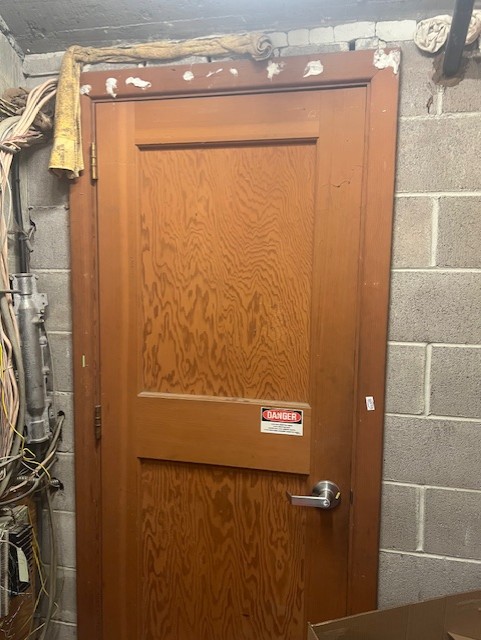
I then inquired about the location of the bomb shelter. Mr. Hockaday replied, “I can’t officially tell you, but it’s under a certain part of the school.” The precise location remains undisclosed, likely to keep people away for safety reasons.
When I asked if he thinks it should be repaired for future use, he commented, “I don’t think so. The cost of repair and cleanup would be extremely expensive. Additionally, it likely isn’t large enough to accommodate all PHS students and staff.” Thus, it seems unlikely that repairs or future use will happen due to space limitations and costs.
Since Mrs. Boisoneau was unfamiliar with the bomb shelter, I asked her whether she thought it should be repaired for future use. She said, “I think emergency preparedness is really important, and we should be ready for situations like that.” She believes it could be useful in an emergency.
I then asked the male security guard how old he thought the shelter was. He suggested, “Like 100 years; it had to be built when the school was built,” which aligns with its historical context, created amid America’s fears of bombing.
Finally, I asked the custodian if he had been down to the shelter. Since he hadn’t heard about it, he hadn’t been there. However, he mentioned that there are tunnels under the school that could be navigated, which is an interesting possibility.
The bomb shelter likely exists somewhere within the building, but no one is permitted to enter or know its exact location, likely due to issues such as mold and deterioration. It appears it will not be used in the future, as it is too small to accommodate all students and would be costly to repair or renovate.